News
Within the framework of the DERHE project, the Chamber of Commerce and Industry of Tirana (CCIT) contributed to bridging the gap between academia and the business sector by bringing forward real challenges identified through collaboration with its partner companies.
Background. Public institutions in Albania are going through a digital transformation. They are digitising records, offering electronic services and introducing new IT systems. This brings benefits but also new risks, such as data security, dependence on technology and the need for new staff skills. Most institutions have no clear assessment of how their employees perceive risk management and digital change.
Problem. Public institutions need to know whether their internal risk culture and the way digital transformation is managed affect efficiency and performance. They also need to know where to invest to improve them.
Questions to be solved:
How do employees perceive risk culture and risk management in their i... >> More info
As part of the DERHE project, the Chamber of Commerce and Industry of Tirana (CCIT) engaged with its partner companies to identify key challenges and practical needs faced by businesses and institutions in Albania. Many Albanian manufacturing companies still have a traditional production structure. Their machinery is often outdated. The production flow is often not linear, which causes unnecessary movement, lost time and high energy consumption. Circular economy principles are rarely integrated into packaging or product development.
Problem. Manufacturing companies need to understand where efficiency is lost in their current production processes. They also need to know how to redesign those processes to reduce energy use, waste and costs without interrupting production.
Questions to be solved:
Where are the critical points of material, energy and time losses on the production line?
How can the production flow be reorganised to avoid unnecessary movement and waiting?
Which en... >> More info
The following challenges were identified through discussions with partner companies of the Chamber of Commerce and Industry of Tirana (CCIT), in the framework of the DERHE project. They reflect real problems faced by companies and institutions in Albania.
Background. Beverage and bottled water producers in Albania use large volumes of plastic (PET) and glass packaging. Their production value chains largely follow the linear “take–make–dispose” model. This leads to high consumption of raw materials, packaging waste and dependence on imported materials. At the same time, the new EU Packaging and Packaging Waste Regulation (PPWR) will set requirements for recycled content and reuse. Albania will align with these requirements as part of the EU accession process.
Problem. Companies in the sector need to identify where in their value chain circular economy strategies can be applied. These strategies must reduce material use and waste and also be feasible within Albania’s current waste... >> More info
The importance of enterprise resource planning (ERP) systems is widely recognised. However, how companies identify and assess their need for these systems remains an important area of research, particularly in transition economies. A study exploring this issue could provide valuable insights into businesses’ needs and perceptions, as well as the factors influencing their decisions to adopt ERP systems. >> More info
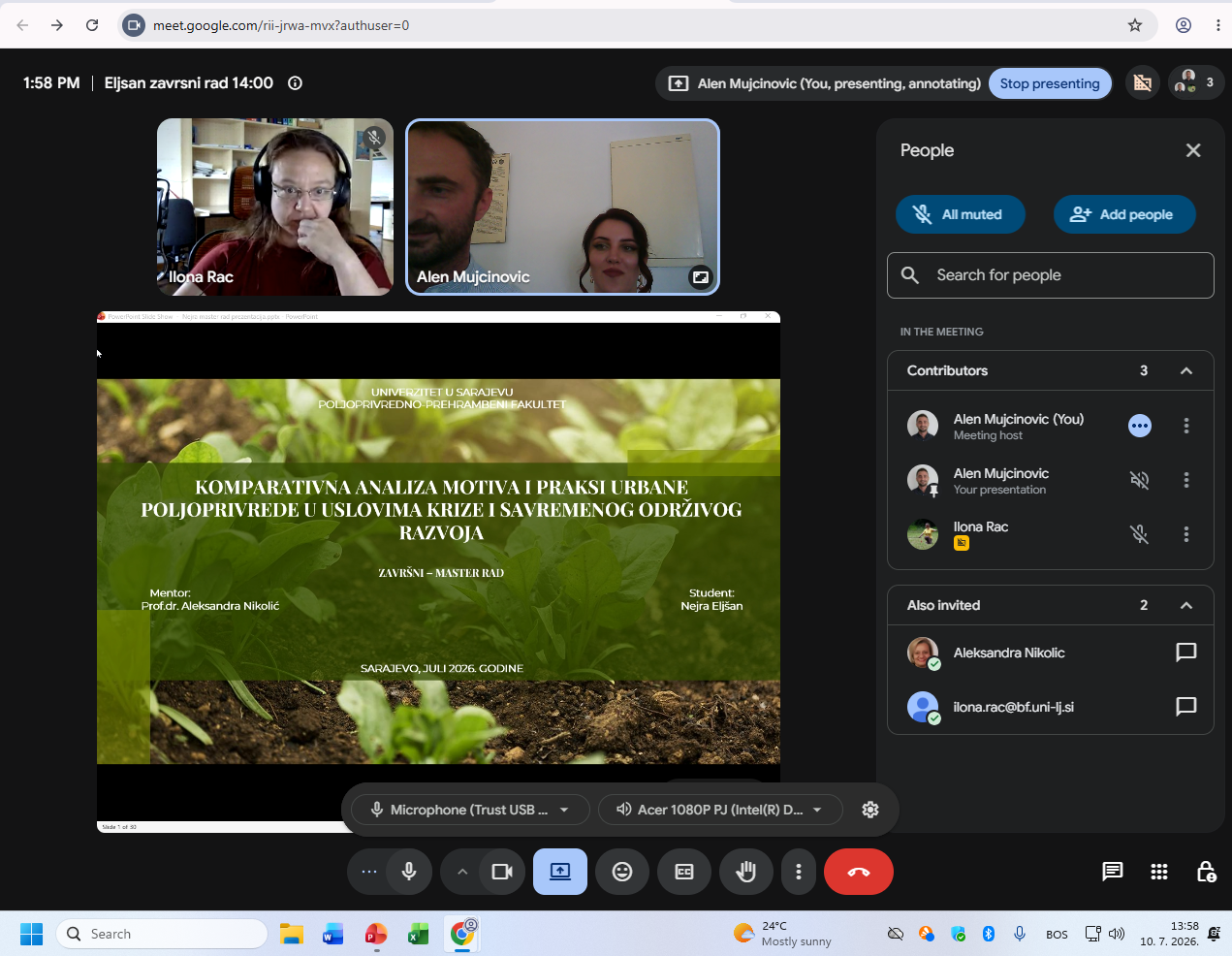
When I think of our DERHE project, I think first of my colleagues and the productive, creative collaboration that enriched both our professional and personal lives. The project truly became a catalyst for change, driving the digital transformation of work and life in exactly the way we had hoped. Its results demonstrate how transdisciplinary and international collaboration can strengthen quality and harmonization across the global higher education landscape—a sector undergoing profound transformation.
A wonderful example of this collaboration is the partnership between the University of Sarajevo and the University of Ljubljana, culminating in the defense of the master's thesis, "Comparative Analysis of the Motives and Practices of Urban Agriculture in Conditions of Crisis and Contemporary Sustainable Development.” The thesis was defended before a committee comprising Assistant Professor Ilona Rac of the University of Ljubljana, Professor Alen Mujčinović, and Professor Aleksandra Nik... >> More info